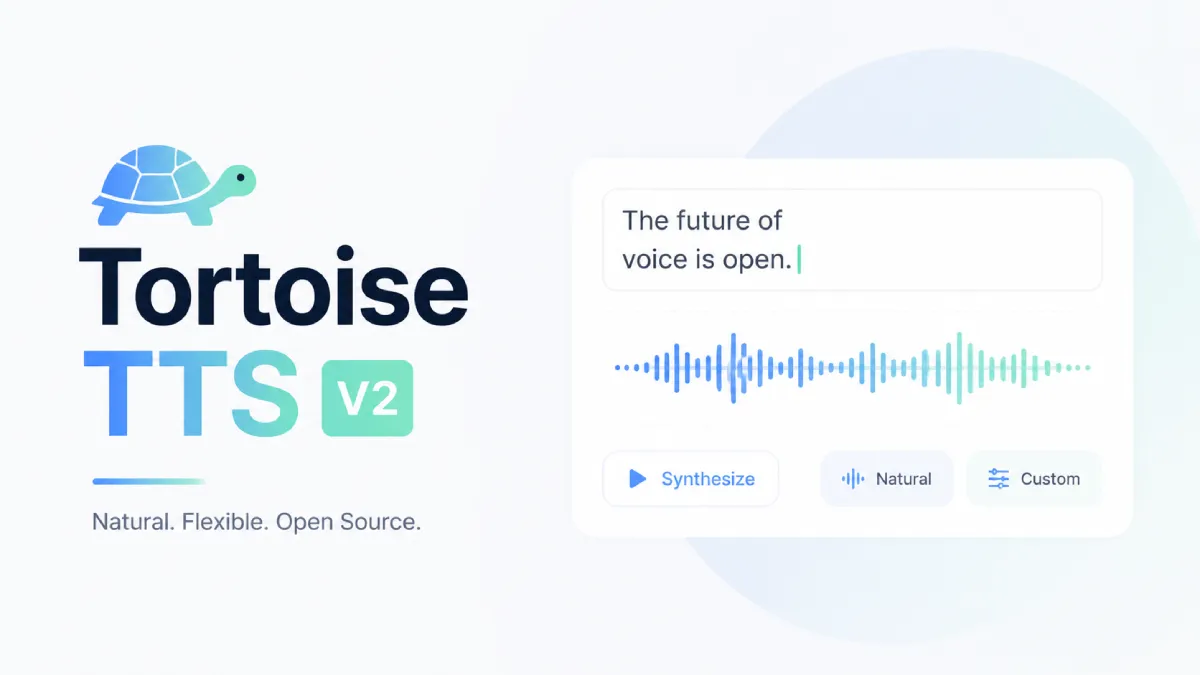
Tortoise TTS v2 gets attention because it aims to solve a very specific weakness in text-to-speech: many voices sound acceptable in short clips but become tiring, flat, or mechanical in longer passages. If you are searching for tortoise tts v2, you are probably not looking for basic text-to-speech. You are trying to understand whether this approach is actually better for realistic narration, long-form listening, or higher-quality AI voice generation.
That is the right question to ask. Voice realism matters, but it is only one part of choosing the right TTS setup. The better option depends on whether you care most about output quality, workflow speed, technical flexibility, or everyday listening convenience.
This guide explains what Tortoise TTS v2 is, why people search for it, where it performs well, what tradeoffs are easy to overlook, and how to decide whether it fits your needs better than a simpler listening-focused solution.
Tortoise TTS v2 is commonly associated with neural text-to-speech designed for more natural, expressive, and less obviously synthetic speech output. It is usually discussed in the context of users who want richer voice quality and more convincing long-form delivery rather than the fastest possible conversion speed.
That distinction matters because people use the phrase tortoise tts v2 with very different expectations. Some are looking for an AI voice model to test. Some want better audiobook-style narration. Others simply want a less robotic way to listen to text.
In practice, this search term usually attracts four types of users:
developers testing advanced AI voice generation workflows
creators comparing narration quality across TTS models
researchers interested in neural speech synthesis quality
users frustrated with generic screen-reader-like voices
These groups overlap, but they do not need the same kind of product. A technically impressive TTS engine is not automatically the best option for everyday listening.
The strongest appeal of Tortoise TTS v2 is not just that it can generate speech. Many tools can do that. The reason it stands out is that it is associated with a more human-sounding reading style, especially in content that requires pacing, tone control, and longer-form continuity.
A lot of TTS tools sound fine in short samples and then start to break down over time. Sentence rhythm becomes repetitive, emphasis feels misplaced, and longer paragraphs lose a natural speaking flow. Tortoise-style systems are often valued because they aim to hold a more coherent delivery across extended text.
When the source text includes punctuation, emotional contrast, or more nuanced phrasing, higher-end neural TTS usually performs better than basic utility-first voices. That can make a meaningful difference for essays, scripts, stories, and content meant to be listened to rather than skimmed.
Some users can tolerate a functional TTS voice for quick reading. Others stop listening quickly if the delivery sounds too synthetic. Tortoise TTS v2 is often part of the conversation because it promises a better listening experience for users in that second group.
The easiest way to evaluate Tortoise TTS v2 is to stop asking whether it is good in general and start asking what job you need it to do.
Tortoise TTS v2 makes the most sense when naturalness is the main priority and you are willing to accept a heavier workflow to get it.
It is usually a strong fit for people who:
want to explore high-quality AI voice generation
care more about realism than speed
are comfortable with technical setup or model-based tooling
are evaluating voice quality rather than just consuming content
For these users, output quality is the product.
If your actual goal is to convert saved articles, class notes, PDFs, or web content into audio you can play on your phone throughout the day, Tortoise TTS v2 may be more than you need. A workflow can be impressive and still be inconvenient.
That matters because daily listening is governed by different criteria:
how quickly you can turn text into audio
how easily you can manage content on mobile
how consistent the experience is across repeated use
whether the workflow supports habit formation rather than one-off testing
For students, busy professionals, and heavy readers, those factors often matter more than squeezing out the highest possible voice realism.
Most discussions around tortoise tts v2 focus heavily on quality and not enough on workflow cost. That leads readers to compare tools in the wrong way.
Better-sounding speech often comes with slower generation, more waiting, or more resource demands. That tradeoff is reasonable for creators producing polished narration, but it is less attractive for users who want near-instant listening.
Advanced TTS workflows often give users more control, but they also expect more from the user. Installation complexity, environment setup, dependency management, and troubleshooting are all part of the real cost.
This is one of the most important distinctions to make. A great TTS model answers, “How natural can the generated audio sound?” A great listening tool answers, “How easily can I turn reading into something I will actually finish listening to?”
For many readers, the right solution is not the most technically impressive one. It is the one that gets used every day. If a TTS workflow is too slow, too technical, or too fragmented, it may lose to a simpler product that makes listening effortless.
A more useful comparison lens is not open-source versus commercial. It is quality-first versus workflow-first.
you are creating narration as a deliverable
you want to evaluate advanced speech generation quality
you are comfortable with technical experimentation
voice realism is your top decision factor
you mainly want to listen to written content more efficiently
mobile playback and convenience matter a lot
you care about speed, consistency, and low friction
your goal is reading completion, study efficiency, or daily learning
That is where AI Listen fits naturally. If your main job is not building voice assets but turning articles, documents, and study materials into something you can actually get through, a listening-first product is often the more practical answer.
The difference is not just technical. It changes what success looks like.
Tortoise TTS v2 is the stronger option when the generated speech itself is the output you care about most. That includes testing voice quality, experimenting with neural TTS, and creating more immersive narration.
A listening app is stronger when the purpose is content consumption rather than voice generation. If you want to turn articles into audio during commutes, review study materials while walking, or clear a backlog of saved reading, usability becomes the deciding factor.
For that scenario, AI Listen makes more sense as part of the solution because it is aligned with reading and study behavior rather than model experimentation. That is a different use case, and treating them as the same leads to bad tool choices.
If you are still deciding whether tortoise tts v2 is right for you, use this checklist.
natural voice quality is your main priority
you can tolerate a slower or more complex workflow
you want to experiment with advanced AI speech generation
you care more about output quality than convenience
you need more reliability and easier deployment
you want faster output with less setup effort
multiple teammates need a predictable workflow
you need a better balance of usability and voice quality
your goal is to finish more reading by listening
you want a smoother mobile-friendly workflow
convenience matters more than deep TTS customization
you need something that supports daily study or information intake
A polished sample clip does not tell you how well a workflow performs over repeated use. Always evaluate setup effort, rendering time, and long-form listening comfort, not just first impressions.
The best TTS solution for a researcher, audiobook creator, student, and casual reader will not be the same. Search intent around tortoise tts v2 is broad, but your workflow should be specific.
Open or flexible tools can still be expensive in time. If you spend too much effort configuring the system, the theoretical quality gain may not be worth it for your actual use case.
Listening to fiction, narrating content for publication, reviewing class notes, and consuming saved articles are four different jobs. A tool should be judged by how well it serves the exact context you care about.
Tortoise TTS v2 matters because it points to a more ambitious tier of AI speech generation: more expressive, more natural, and more appealing to users who are dissatisfied with flat or robotic text-to-speech. But that advantage is meaningful only if your workflow justifies the extra complexity.
If your priority is experimentation, narration quality, or advanced AI voice output, Tortoise TTS v2 is worth serious attention. If your priority is turning reading into a consistent listening habit, a workflow-first option may be the smarter choice. In that case, AI Listen is relevant not as a direct model substitute, but as a practical way to make written content easier to consume every day.
The best decision is usually not about choosing the most impressive TTS system. It is about choosing the one that best matches how you actually listen.