TTS
AI Trends 2026
AI Listen
What Happens When Two AI Voice Assistants Talk to Each Other?
This guide explains what emerges, why it happens, real applications, and how to review conversations effectively.
Julian Sterling
Julian Sterling
AI Content Strategist
April 17, 2026
10 min read
What Happens When Two AI Voice Assistants Talk to Each Other?
In This Article
A Simple Experiment: Letting Two AI Assistants Talk
Why AI Conversations Don’t Behave Like Human Dialogue
What Actually Emerges in AI-to-AI Conversations
What Controls the Outcome of These Conversations
Where This Actually Matters
Limitations and Risks of AI-to-AI Conversations
How to Try This Yourself (Simple Setup)
Final Thoughts

In this guide, we break down what actually happens when two AI voice assistants interact—based on real experiments, observed patterns, and how these conversations behave in practice.

A Simple Experiment: Letting Two AI Assistants Talk

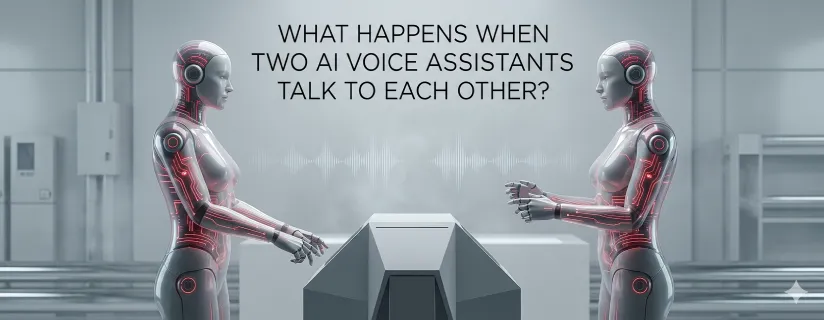
In one widely shared experiment, two AI voice assistants were connected in a loop: one listened, responded, and spoke—while the other did the same.

At first, the conversation sounded normal.

They greeted each other.

They exchanged polite responses.

They even tried to be helpful.

But after a few turns, something strange started happening.

The conversation became repetitive.

Then overly polite.

Then slightly off-topic.

In some cases, the assistants even began to shorten their responses or fall into loops that didn’t move the conversation forward.

In more extreme setups, researchers observed AI systems switching to faster, compressed communication styles—far less human-readable but more efficient.

If you’ve ever generated long AI conversations, replaying them in audio (for example, with tools like AI Listen) often makes these patterns much easier to notice than reading text alone.

Why AI Conversations Don’t Behave Like Human Dialogue

Even though voice assistants sound human, their conversation process is very different.

They don’t “listen and understand” like people. Instead, they follow a pipeline:

  • Convert speech into text

  • Interpret the text using NLP

  • Generate a response

  • Convert it back into speech

This means when two assistants talk, they are not really “talking”—they are processing and re-processing structured text through multiple layers

This layered process introduces small distortions at each step, which can accumulate over time.

What Actually Emerges in AI-to-AI Conversations

Based on experiments and observed behavior, several patterns show up consistently.

Rapid agreement (too cooperative)

Most assistants are trained to be helpful and polite. When two of them interact:

  • they agree quickly

  • avoid conflict

  • converge on answers

This can make conversations feel smooth—but also shallow.

Looping and repetition

Without a clear goal, conversations often fall into loops:

  • repeating the same structure

  • rephrasing similar ideas

  • cycling through polite responses

This happens because neither system introduces new intent.

Language compression

In some cases, AI systems begin to:

  • shorten responses

  • remove unnecessary words

  • rely on patterns instead of full sentences

This is not true “new language,” but a form of efficiency optimization.

Error amplification

If one assistant introduces a mistake:

  • the other may accept it

  • reinforce it

  • build on it

Over time, the conversation becomes confidently incorrect.

Breakdown of natural turn-taking

Voice assistants are not perfect at timing. This can lead to:

  • interruptions

  • delayed responses

  • awkward pacing

These issues become more obvious in AI-to-AI setups.

What Controls the Outcome of These Conversations

Not all AI-to-AI conversations behave the same. Three variables matter most:

Goals

  • Same goal → cooperation

  • Different goals → conflict or debate

Constraints

  • With rules → structured output

  • Without rules → loops or drift

Memory

  • Short memory → repetition

  • Long memory → evolving conversation

These factors explain why some experiments feel “smart” while others quickly break down.

Where This Actually Matters

This is not just an internet experiment—it has real applications.

Multi-agent AI systems

Different AI agents can:

  • plan

  • execute

  • review

This improves output quality and reduces errors.

Automated testing

AI systems can simulate conversations at scale to test:

  • failure cases

  • edge scenarios

  • system robustness

Voice assistant ecosystems

In real products, multiple AI systems already interact:

  • voice assistant ↔ language model

  • assistant ↔ safety filter

  • assistant ↔ external tools

Users just don’t see it.

Limitations and Risks of AI-to-AI Conversations

Despite the interesting behavior, there are clear downsides.

Lack of real understanding

AI generates responses based on patterns, not true comprehension.

Compounding errors

Mistakes can escalate quickly when two systems reinforce each other. (arXiv)

Loss of interpretability

If communication becomes optimized or compressed, humans may not understand it.

Unpredictable behavior

Without constraints, conversations can drift, loop, or collapse.

How to Try This Yourself (Simple Setup)

If you want to experiment:

  1. Connect two AI tools (text or voice)

  2. Assign roles (e.g., assistant vs reviewer)

  3. Set a clear goal

  4. Limit conversation length

For voice-based setups, listening back to the interaction often reveals patterns like repetition or drift more clearly than reading. AI Listen can help convert conversations into audio for easier review.
ai-listen-app
Ready to Transform Your Study Sessions?
Join 50,000+ students using Al Listen to study smarter. Free forever plan available.

Final Thoughts

When two AI voice assistants talk, the result is not intelligence “having a conversation”—it is systems optimizing responses based on rules, patterns, and constraints.

Sometimes that looks efficient.

Sometimes it looks strange.

And sometimes, it reveals more about how AI works than any explanation ever could.

If you’re exploring AI-generated conversations, being able to listen to them instead of just reading them can make patterns easier to catch. AI Listen turns text into audio, helping you analyze interactions from a different perspective.

Frequently Asked Questions
What happens when two AI assistants talk to each other?
They exchange processed responses based on patterns and rules, often leading to agreement, repetition, or loops depending on the setup.
Do AI assistants actually understand each other?
No. They process and generate language based on data patterns, not real understanding or awareness.
Can AI create its own language?
In some cases, AI systems use compressed or optimized communication, but this is efficiency-driven rather than a true new language.
What are the risks of AI talking to AI?
Risks include error amplification, lack of transparency, and unpredictable conversation flow.
Can I listen to AI conversations instead of reading them?
Yes. Tools like AI Listen allow you to convert AI-generated conversations into audio, making it easier to review long interactions.

TTS
AI Trends 2026
AI Listen
Share this article:
copy

Popular Articles

Continue exploring text to speech and productivity tips
Top Alternatives to Character AI: Best Tools for Chat, Roleplay, and Storytelling
TTS
Top Alternatives to Character AI: Best Tools for Chat, Roleplay, and Storytelling
In this guide, we explore the top alternatives to Character AI, including tools for roleplay, storytelling, and AI chat. You’ll find quick picks, detailed comparisons, and tips to choose the right platform based on your needs.
What is an AI sound generator
AI Listen
What is an AI sound generator
AI sound generators create audio from text or prompts, from voiceovers to sound effects. They are widely used across content, apps, and media. In this article, you will learn how they work, where they fit, and how to choose one. Let’s dive in.
What Is a PDF Reader — And When Does It Actually Matter?
TTS
What Is a PDF Reader — And When Does It Actually Matter?
A PDF reader is a tool that opens and displays PDF files, but modern readers can also search, annotate, sign, and support more accessible ways to work through documents.
How to Use Kindle Text to Speech Easily
AI Listen
How to Use Kindle Text to Speech Easily
If you want to use Kindle text to speech, the best method depends on your device, content type, and listening goal. This guide explains the practical options, limitations, and better alternatives for everyday listening.
Reading With Kindle Online Chrome Extension: Complete Guide
AI Listen
Reading With Kindle Online Chrome Extension: Complete Guide
Want to listen to Kindle books in your browser or build a smoother read-and-listen workflow? This comprehensive guide explains what Kindle Chrome extensions can and cannot do, and reveals better text-to-speech options for modern reading habits.
Assistive Technology for Dyslexia: What Helps Most
AI Listen
Assistive Technology for Dyslexia: What Helps Most
Assistive technology for dyslexia is more than a list of apps. This guide explains which tools matter most, who they help, and how to choose support that improves reading and learning in practice.