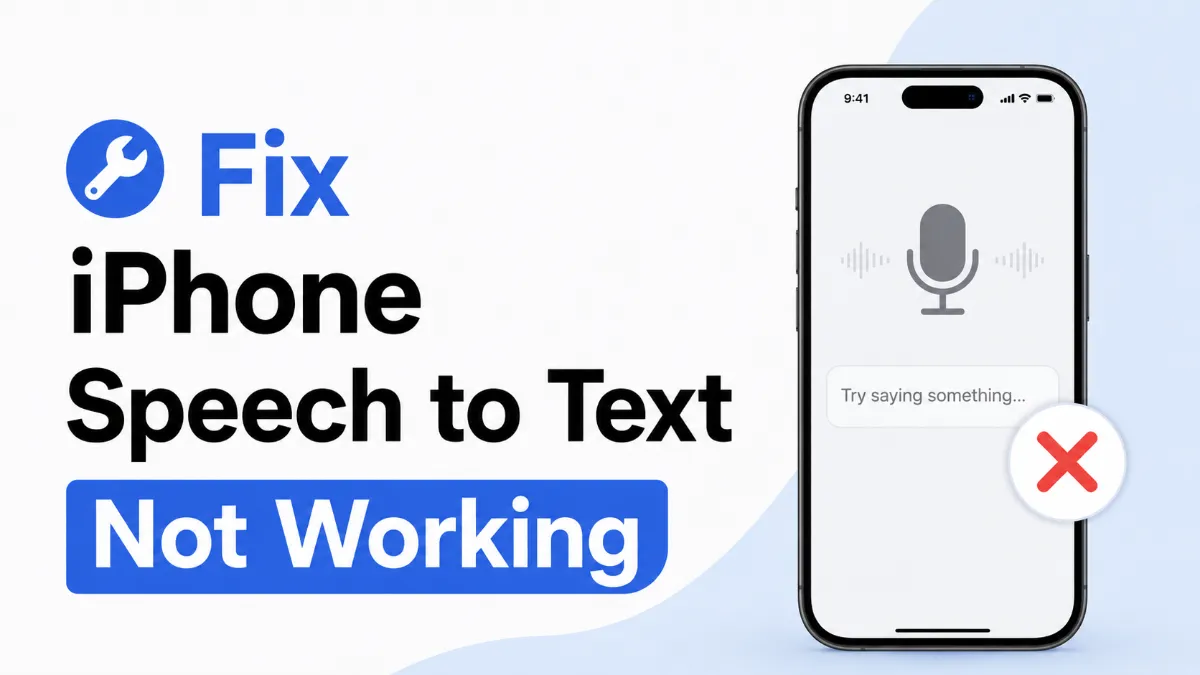
iPhone Speech to Text Not Working? Here's How to Diagnose and Fix It Fast
When iPhone speech to text stops working, the cause is almost always one of a handful of settings issues — not a hardware failure. This guide walks you through a structured diagnostic process to find and fix the problem quickly.
Sienna Moretti
AI Audio Consultant
June 21, 2026
7 min read
In This Article
Quick Check: The Most Common Reason Dictation Stops Working
Software Fixes: Step-by-Step Troubleshooting
Screen Time and Permission Issues
When It Might Be a Hardware Problem
After an iOS Update: What to Check First
The Bottom Line
When iPhone speech to text stops working, the instinct is to assume something broke. But in the vast majority of cases, the problem is a settings change — one that happened silently during an iOS update or was triggered by a Screen Time restriction.
The diagnostic process here is designed to get you from "it stopped working" to "it's fixed" as quickly as possible. Start with the most common causes, and only escalate to hardware checks if the software fixes don't resolve it.
Quick Check: The Most Common Reason Dictation Stops Working
Before running through a full troubleshooting list, check this first:
Settings > General > Keyboard > Enable Dictation
If that toggle is off, turn it back on. This single setting change is responsible for the majority of "iPhone speech to text not working" reports — particularly after iOS updates, which occasionally reset it without warning.
If it's already on and the problem persists, continue with the steps below.
Quick Tip: If iPhone speech to text stops working after an iOS update, the most likely cause is that the update reset your Dictation or Siri settings. Before running through all the steps below, go directly to Settings > General > Keyboard and check if Enable Dictation is still toggled on — iOS updates occasionally disable it without warning.
Software Fixes: Step-by-Step Troubleshooting
Work through these in order. Each step takes under a minute.
Step 1: Confirm Dictation Is Enabled
Go toSettings > General > Keyboard.
Toggle onEnable Dictationif it's off.
Tap "Enable Dictation" in the confirmation popup.
Open any app with a text field and check if the microphone icon appears on the keyboard.
Step 2: Check That Siri Is Active
Dictation depends on Siri being enabled on your device.
Go toSettings > Siri & Search.
Make sure"Listen for Hey Siri"or"Press Side Button for Siri"is on.
If Siri was disabled, re-enable it and test Dictation again.
Step 3: Verify Microphone Permissions
If an app's dictation isn't working (e.g., voice input in a specific app), that app may have lost microphone access.
Go toSettings > Privacy & Security > Microphone.
Find the app in question and make sure its toggle is on.
If the system keyboard's dictation isn't working (rather than an app), this won't apply — the system keyboard has implicit permission.
Step 4: Restart Your iPhone
A clean restart clears temporary states that can block audio input processing.
iPhone X and later: Press and hold the Side + Volume Down button, swipe to power off, then power back on.
iPhone SE or older: Press and hold the Side button, swipe to power off.
Test speech to text after restarting before moving to the next steps.
Step 5: Check Your Language and Region Settings
Speech to text may stop working if the keyboard language and the Dictation language mismatch.
Go toSettings > General > Keyboard > Keyboards.
Confirm the active keyboard language matches your spoken language.
InSettings > General > Language & Region, verify your region settings are correct.
Step 6: Update iOS
If you're on an older iOS version, a known bug may be causing the issue.
Go toSettings > General > Software Update.
Install any available update.
After updating, recheck the Enable Dictation setting — updates can reset it again.
Screen Time and Permission Issues
If you're troubleshooting a child's iPhone or a device managed by another account, Screen Time restrictions can block speech to text entirely.
Go toSettings > Screen Time.
TapContent & Privacy Restrictions.
TapAllowed Apps.
Make sureSiri & Dictationis toggled on.
If Screen Time is password-protected and you don't know the password, you'll need to contact whoever manages the device. The dictation microphone icon will not appear at all when this restriction is active.
When It Might Be a Hardware Problem
If you've completed all the software steps and speech to text still doesn't work, test the microphone hardware directly.
Test with Voice Memos:
Open theVoice Memosapp.
Tap the red record button.
Speak normally for a few seconds.
Play it back.
Interpreting the result:
Clear recording: The microphone hardware is fine. The issue is software-related and likely tied to a setting you haven't found yet — contact Apple Support for further help.
Muffled or distorted audio: The bottom microphone may be blocked by debris. Try cleaning the microphone port gently with a soft brush.
No audio at all: This suggests a hardware failure. Contact Apple Support or visit an Apple Store for diagnosis.
After an iOS Update: What to Check First
iOS updates are the single most common trigger for speech to text problems. When an update breaks Dictation, here's the fastest fix sequence:
Enable Dictation(Settings > General > Keyboard) — most commonly reset
Re-enable Siri(Settings > Siri & Search) — occasionally toggled off during updates
Check Screen Time(Settings > Screen Time > Content & Privacy Restrictions > Allowed Apps > Siri & Dictation) — update may have re-applied restrictions
If all three are already on and Dictation still doesn't work, restart the device before trying anything more complex. A full restart after an iOS update often clears residual issues.
The Bottom Line
iPhone speech to text not working is almost always a software settings issue, not a broken microphone. The Enable Dictation toggle being off accounts for the majority of cases — check that first. For everything else, the step-by-step flow above covers the full range of common causes in the order most likely to resolve the problem quickly. Hardware issues are rare; don't go there until you've ruled out every software cause. In the meantime, if you need a way to consume text as audio on your device,AI Listenworks independently of Siri and dictation settings — useful while you work through the fix.
Why did iPhone speech to text suddenly stop working?
The most common reason is that a recent iOS update reset the Dictation setting. Go to Settings > General > Keyboard and check that Enable Dictation is still on. If it was disabled, re-enabling it usually restores speech to text immediately.
How do I fix speech to text not working on iPhone?
Start with the basics: confirm Enable Dictation is on (Settings > General > Keyboard), check that Siri is enabled (Settings > Siri & Search), and verify no Screen Time restriction is blocking Siri & Dictation. If those are all fine, restart your iPhone and test again.
Can Screen Time block iPhone speech to text?
Yes. If Screen Time is enabled and Siri & Dictation is restricted, the microphone icon won't appear on your keyboard. Go to Settings > Screen Time > Content & Privacy Restrictions > Allowed Apps and make sure Siri & Dictation is turned on.
Why is the microphone icon missing from my iPhone keyboard?
The microphone icon disappears when Enable Dictation is turned off in Settings > General > Keyboard. It can also be hidden if Siri is disabled. Both settings need to be active for the microphone icon to appear on the keyboard.
Could it be a hardware issue with my iPhone microphone?
Possibly, but rarely. Test by opening the Voice Memos app and making a short recording. If the recording picks up your voice clearly, the microphone hardware is fine and the issue is software-related. If the recording is silent or muffled, there may be a hardware issue requiring service. While troubleshooting, AI Listen can serve as a workaround for audio content — it reads text and documents aloud on iPhone without relying on the microphone or dictation features.
TTS
AI Listen
Tutorials
Tips & Tricks
Share this article:
Table of Contents
Quick Check: The Most Common Reason Dictation Stops Working
Software Fixes: Step-by-Step Troubleshooting
Screen Time and Permission Issues
When It Might Be a Hardware Problem
After an iOS Update: What to Check First
The Bottom Line
Ready to Transform Your Study Sessions?
Join 50,000+ students using AI Listen to study smarter. Free forever plan available.
AI story generators turn prompts into structured drafts for fiction, marketing, and education. In this guide, we cover how AI story generators work, their core features, benefits, limitations, and how to choose the right AI Story Generator.
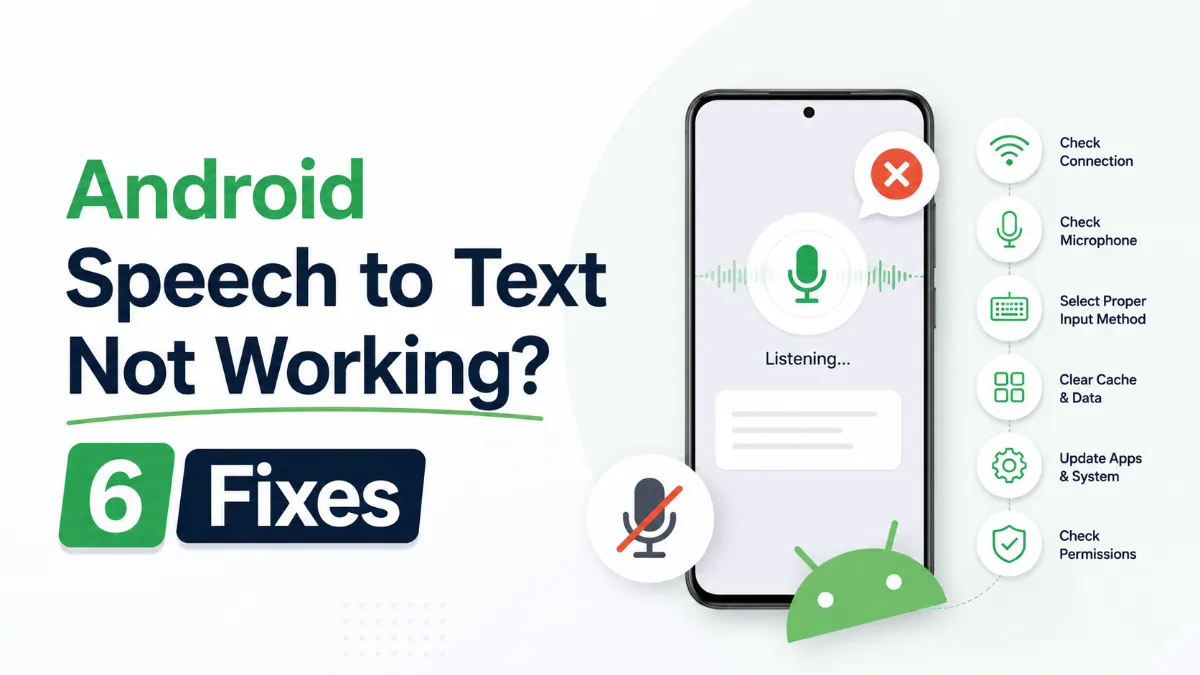
Android speech to text failures usually trace back to a small set of causes: permissions, cache buildup, language mismatches, or internet dependency. Here are six fixes that cover the most common cases, in order of effort.
The Android text to speech engine is the system-level layer that converts text to audio for all apps on your phone. Most users never change it — but knowing how to switch engines, download better voices, and configure it correctly can significantly improve TTS quality.
Android’s text to speech tools range from a built-in accessibility engine to dedicated apps designed for longer listening sessions. This guide covers how to use each, and which option fits your workflow.
Assistive technology for dyslexia is more than a list of apps. This guide explains which tools matter most, who they help, and how to choose support that improves reading and learning in practice.