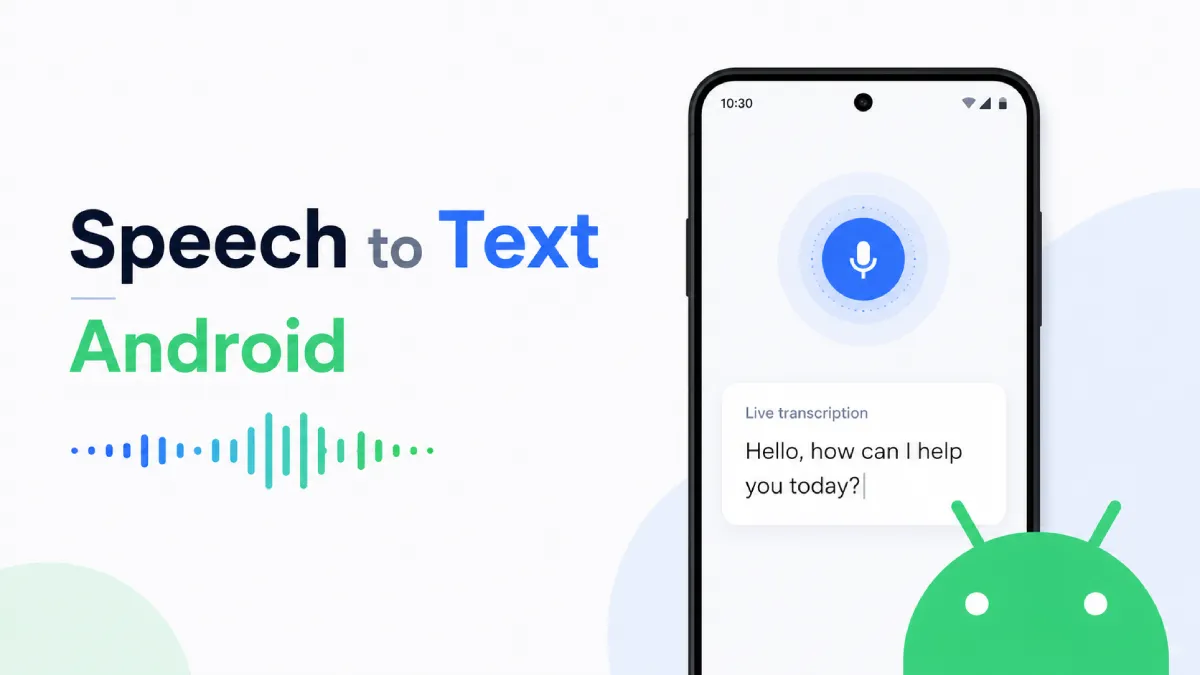
Android speech to text has quietly become one of the most capable free tools on any mobile platform. Whether you need to dictate a quick message, transcribe a meeting, or caption live conversations for accessibility, the built-in options are strong — and the third-party ecosystem has grown significantly. The challenge is that Android isn't one unified experience: Samsung, Pixel, and other brands have different settings paths, different pre-installed keyboards, and in some cases different voice engines under the hood.
This guide covers everything from zero-step activation to app-by-app comparisons, including what works offline, what handles multiple speakers, and where the built-in tools fall short.
Android's speech to text operates at two levels.
Keyboard-level dictation converts your voice to text in any text field. Gboard — Google's keyboard, pre-installed on Pixel and most Android devices — includes voice typing that connects to Google's speech recognition engine. It's fast, accurate for standard English, and requires no additional setup.
System-level tools like Google's Voice Access and Live Transcribe operate outside the keyboard. Voice Access lets you control your phone with voice commands. Live Transcribe turns any spoken audio into on-screen captions in real time, designed primarily for the Deaf and hard-of-hearing community.
Third-party apps handle use cases neither of these covers well: long-form recordings, meeting transcripts with speaker identification, or specialized vocabulary for legal and medical dictation.
Understanding which layer you need saves time when troubleshooting or choosing an app.
The steps vary slightly by brand, but the core path is the same.
On Pixel (stock Android 14/15):
Tap any text field to open the keyboard
Tap the microphone icon on the Gboard toolbar
Speak — transcription appears in real time
On Samsung Galaxy (One UI):
Tap a text field to open the Samsung Keyboard
Tap the microphone icon at the top of the keyboard
If using Gboard instead: tap the mic icon in the toolbar
On other Android brands (Xiaomi, OnePlus, etc.):
Open Settings > General Management > Language and Input
Tap On-screen Keyboard > Gboard > Voice Typing
Ensure Voice Typing is enabled, then use the mic icon in any text field
Enabling Voice Access (hands-free control):
Download Google Voice Access from the Play Store
Go to Settings > Accessibility > Voice Access
Turn it on — you can now speak commands to navigate your phone
The right app depends on what you're actually transcribing.
App | Best For | Key Strength | Main Limitation |
|---|---|---|---|
Gboard (built-in) | Quick messages, notes | Zero setup, always available | Pauses after silence, no history |
Live Transcribe | Real-time captions, accessibility | Offline support, speaker detection | No transcript export in free version |
Meetings and interviews | Speaker ID, summaries, integrations | 300 min/month on free tier | |
VOMO | Journalists, long audio | Unlimited recording length | Subscription for full features |
Notta | Multilingual users | 58 languages, real-time translation | Higher price point |
Dragon Anywhere | Legal, medical, professional | Custom vocabulary, high accuracy | Most expensive option |
Whisper (via clients) | Privacy-focused users | On-device, no cloud upload | No live dictation, setup required |
Samsung Galaxy AI deserves a separate mention. On Galaxy S24 and later, Samsung includes on-device AI transcription that integrates with the Notes app and supports real-time translation. For Galaxy users who primarily need meeting or voice notes transcription within Samsung's app ecosystem, this is worth exploring before installing third-party apps.
Several factors influence how accurate Android voice typing gets in practice — and most users don't realize these are adjustable.
Microphone quality matters more than the app. Dictating in a quiet room with a phone held near your mouth produces dramatically better results than speaking at arm's length in a noisy environment. For meeting transcription, an external Bluetooth mic or a dedicated recording device improves accuracy substantially.
Language and accent handling varies by engine. Google's speech engine handles a wide range of accents for major languages, but performance drops for less-common language variants. If you're dictating in a non-English language or with a strong regional accent, Notta and Dragon Anywhere train better on specific accent profiles.
Technical vocabulary isn't recognized by default. Legal terms, medical terminology, and industry jargon frequently get misrecognized. Dragon Anywhere allows you to add custom vocabulary. For other apps, speaking more slowly and enunciating clearly helps, but there's no permanent fix without custom vocabulary support.
Gboard's voice typing is not designed for meeting transcription. It stops after detecting silence and produces no timestamps, speaker labels, or summaries. Attempting to transcribe a one-hour meeting using Gboard would require manually restarting it continuously.
For live meetings, Otter.ai and Notta are the most practical options. Both record continuously, identify who is speaking, and produce a searchable transcript with an auto-generated summary.
For audio files you've already captured — voice memos, recorded interviews, uploaded audio — VOMO allows you to import the file and receive a full transcript without real-time recording.
A useful Android workflow for note-heavy users: record meetings with Otter.ai on your Android phone, export the transcript, then use a TTS tool to listen back through long transcripts on another device. If you also use iOS devices, AI Listen can read any exported transcript back to you as natural audio — useful when reviewing long meeting notes while commuting.
Live Transcribe is one of Android's most underappreciated apps. Designed for Deaf and hard-of-hearing users, it captions live speech in real time on your phone screen — but it's genuinely useful beyond accessibility:
In-person conversations where you can't hear clearly
Lectures or presentations where you want a live text record
Noisy environments where reading captions is easier than listening
Live Transcribe supports over 70 languages, runs on-device for major languages (no internet needed), and detects sound events like laughter, applause, and alarms. It doesn't export transcripts in its free version, but the Pro tier adds that capability.
Both platforms handle everyday voice dictation well in 2026. The differences that actually matter:
Settings fragmentation: Android's speech to text path varies by manufacturer. iPhone has one unified path (Settings > General > Keyboard). For less tech-savvy users, iPhone's consistency is a practical advantage.
App ecosystem: Both platforms have access to the same major STT apps (Otter.ai, Dragon, Notta). The gap is smaller than it was three years ago.
Offline support: Android's Gboard offline voice typing is solid for English. iPhone's on-device Dictation (iOS 16+) is comparable. Both require language downloads for offline use.
Accessibility tools: Android's Live Transcribe has no direct iPhone equivalent for real-time live captioning without a third-party app. This is a genuine Android-only advantage.
Samsung Galaxy AI: For Galaxy device users, Samsung's integrated AI transcription adds capabilities not available on iPhone without a third-party app.
Neither platform is clearly better for all users. The right choice depends on your existing ecosystem and which apps you use most.
For quick text input, Gboard's built-in voice typing is all you need — it's already on your phone, requires no setup, and works accurately for everyday messaging and notes. For meetings, long recordings, or accessibility use cases, a dedicated app fills the gaps the built-in tools weren't designed for.
If you use multiple devices and want to review your transcribed content hands-free on iOS, AI Listen converts any text into natural-sounding audio — a practical companion to Android's speech to text workflow.